
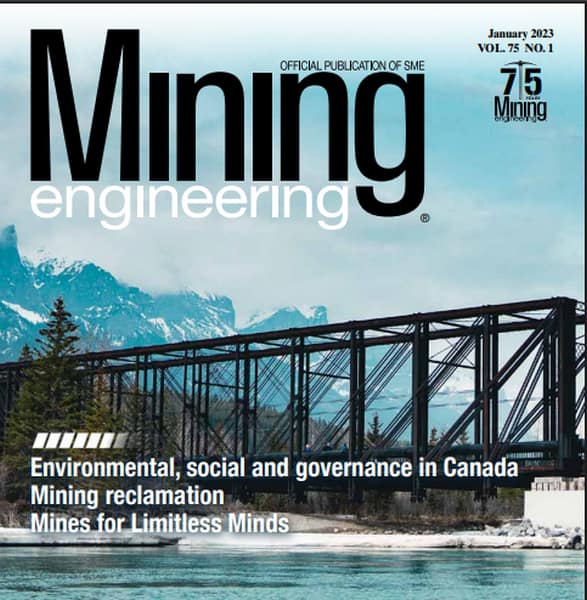
It used to be that Mining Engineering magazine was for me a suitable read before the plane took off for some destination in the Empire, a great aid to sleep as the plane climbed to cruising altitude and before the flight attendant could bring you the first drink. An easy check-off on the day’s to-do list. Stale news about mining properties and transactions, promotions or deaths of colleagues, the rare technical article of modest interest. ‘Bout the time you got to the “WAIME” or the “Professional Services” section you were dozing peacefully with the magazine forgotten in the seatback pocket, left for the cleaning crew.
As it is late summer in the Northern Hemisphere now, it’s time to put off chores and lists, and to find tedious books and publications like all those unread motivation books and trade publications to help one doze off in one’s lounge chair by the lake at siesta time. But one of these rags no longer facilitates healthy late summer afternoon snoozes; with this post I will put this problem to bed, so-to-speak.
Problem
These days, Mining Engineering is a head-shaking experience that results in rapid page-flips, a surge in systolic blood pressure, and a well-aimed (and deserved) toss over to File 13. The articles seem disconnected from the chapter meetings where, while the speaker’s subject may be boring (i.e., drilling, blasting, ground support—yawn), at least it’s about mining and there’s cheap food and drink. The magazine seems to be a device for promulgating the U.N. agenda, a narrative comprising grift, opportunism, and corruption. The magazine is full of new buzzwords, undefined terms, unproved assumptions, false consensus thinking; i.e., Newspeak – for a full explanation of the term see the appendix included in the book 1984 (Orwell, G., 1949). It’s a magazine written by the mining elites, a tiny and relatively insignificant group of people used as tools who are working de facto, or outright, for the people who really call the shots. It’s about getting us all to march to the same tune (over the cliff). If this is the face of SME, the organization is not leading, it’s following, and expecting we professionals to get on board with 2050 net-zero, the energy transition, DEI, sustainability, critical minerals–effectively the flavor of the day. It’s just a coinky-dink that 75 years ago Orwell predicted a full transition from Oldspeak to Newspeak by 2050. Every time I open this Mining Engineering rag my eyes just trip over all the B.S. inside it. There’s now even a “Green News” section. A society of professionals should be calling this stuff out. It’s not. It’s going along to get along. Taking the jab, as it were, and recruiting more victims. Most importantly, this magazine is no longer recommended here for nap time.
Method and Analysis
By my nature a habitual miner, three parts geo and 1 part engineer, my reaction to the situation is to tabulate and chart the Newspeak terms with metrics1. Table 1 shows total occurrences of search terms related to the Narrative(s) at ± quarterly intervals as published in Mining Engineering issues over the last three years. Consider it a heat map of virtue-signaling wokeness, leavened with uncritical thinking, with a dash of greed for good measure, and, from a conspiracy angle, designed to evoke reaction from grumpy old dinosaurs. The narratives pushed by all the different useful agents and tools first knock the legs out from under the way we think and do business, then present and react to a crisis, and finally propose a solution. For those who know how this all works and who set these agendas in motion, there’s money and power to be had at each step. The reward for the technical foot soldiers; e.g., management, workers, geologists and engineers, is being happy for a time helping to “solve” the latest crisis. The chart is divided into three regions which can be thought of Destabilization (top), Panic (Middle), and Redirection (Bottom).
Table 1 Heat map showing search results for multiple Newspeak factors in recent Mining Engineering issues
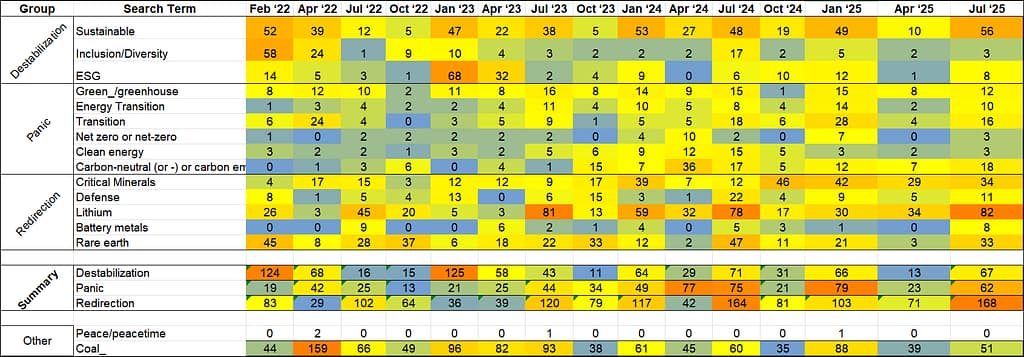
Overall, the heat map shows a warming trend, not to be confused with Global Warming, from left to right. It is uneven; the category summary at the bottom of the chart smooths some of the variations and confirms the general warming trend. Perhaps the more sophisticated and granular analysis given below will resolve some of the apparent noise between issues.
The line graph shown in Figure 1 helps to visualize the broad Newspeak trends in a different way using the three summaries for the Destabilization, Panic, and Redirection categories. The trigger counts in each column of the heat map for all the components in each of the three categories, summed and plotted as the solid lines or dashed moving average, compose indices.
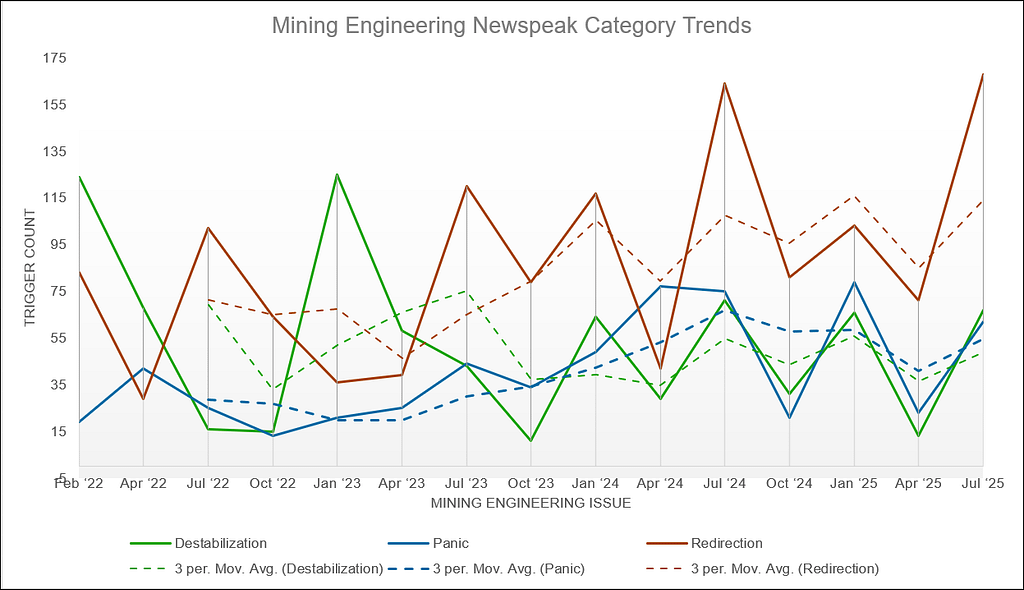
Figure 1 Newspeak category trends from February 2022 to July 2025
The data is the same as in the Summary section of the heat map but shown as lines instead of colored cells. The monthly variations are erratic, whereas the 3-issue moving averages (dashed lines) help to elucidate the trends over longer time periods. Some comments on each index are offered in the following sections.
Destabilization Index
One could go back farther, but the date range included in Figure 1 shows a few things. Destabilization includes “woke” terms and coercive policies. Destabilization was hot, but only Sustainability survived as a suitably vague term to mean anything a corporation or professional society interested in pleasing its masters wants it to mean. Inclusion and Diversity, proxies for the D.E.I. agenda are definitely on the outs – heard much about pronouns lately? No longer sharing details of your hormone therapy in the company chat? ESG is still lurking even though there has been lip service about minimizing it (e.g., Vanguard ends membership in Net Zero Asset Managers Initiative in 2022 but may be sneaking back). I think it’s still a big deal because it’s a cover for the next two groups despite a recent leveling off. Figure 1 shows that Destabilization has “stabilized” and is now just part of the regular diet of Mining Engineering readers.
From my own experience I enthusiastically support diversity. An example is a project in Colorado that I directed for a while where our office and core shed building was a packrat-infested, falling down ruin about 100 years old. One of the team was a geologist—call him Marv—who had odd dietary habits that required accommodation. He would come up from underground around mid-day and announce loudly: “It’s about time to strap on the ol’ feed bag!” Then, I can still see him opening a can of beans with a jackknife and putting it right on the burner to heat up (this would be a good “safety share” in the next meeting, Campers). After a while, there might be this awful smell of burning beans and we’d be yelling: “Marv!” What the H___?” He also had a rather good nose for food scraps that other people left in the garbage and appreciated them as no one from our refined geology culture “normally” would. We learned to be kind. He was from Chicago originally and added great diversity to our team.
And I also support equity2 deeply. A VP of a silver mining company gets $2.5M/yr and half of the employees get $117k/yr or less. That executive gets about 20x the median. The CEO of a gold company with headquarters in Canada gets $10.1M/yr, about 140x the median salary in his company. The ratios could be re-stated by saying the silver company executive works 20x as hard as his employees and the gold company executive works 140x as hard as his motley crew. Therefore, these executives should fire all those extra employees and hire more executives who do way more work than anyone else in their companies based on the ratio of their salaries. It’s only fair…and equitable that way, right? And you save on office space, too.
Carrying this reasoning further, the silver executive should be fired, too, or his company merged into the gold company whose CEO salary imputes a much more efficient management style.
Inclusion? I don’t know. I keep thinking about Marv—what if there had been more than one of him in the team?
Panic Index
Next, we get to the middle group in Figure 1, the carbon and climate thing. This is a manufactured crisis and with a mandated consensus. It has its own language and requires a variety of search terms to capture. It’s not a subtle brainwashing, but it has a suite of terms that can be used to gain entry to the club; e.g., “… for the green energy transition”. Nope, not talking about turning Mark into Mary here. They can’t decide if it’s “net-zero” or “net zero”. Search just “carbon” and it’s all mostly about how to minimize it. Good luck! It’s the 15th most abundant in Earth’s crust. But it looks like the fervor is increasing since the heat map shows a climb toward the present. It’s a never-ending battle – too cold, too hot, too wet, too dry, big storms, cats sleeping with dogs… Years of media mind control paying off, eh? Carbon—bad. Carbon—bad. Except when you can trade credits and make money at it!
Figure 1 shows that Panic has a generally positive 3-month moving average trend but has recently leveled off. Apparently, the mild pushback on this issue reflects some societal exhaustion with the themes. At some point, any sustained drop in the Panic Index will affect City of London and Wall Street profits and will need to be addressed. However, evidence suggests that Panic Index categories reflect more episodic and short-term manipulation than other indices. There are some indications that the lucrative speculation in A.I. stocks and roll-out of stablecoins is responsible for the current lull, but beware, a panic might shortly be necessary to give these grifts a little extra little push. Climate Emergencies! Measles outbreaks! Whirling disease! Forest fire lockdowns! Soaring sanctuary city crime! Panic!
Redirection Index
The bottom group in Figure 1 is the one that which shows the most rapid reaction of SME to the immediate perceived need or narrative, as if someone were shooting at its heels yelling “Dance, SME, Dance! No need for Newspeak with this one. “Hello [Bolivia], whats happening? Ummm, I’m gonna need you to go ahead and give me your lithium tomorrow, Mm-kay? (like the boss Bill Lumbergh in the movie Office Space, https://movie-sounds.org/comedy-movie-sounds/quotes-with-sound-clips-from-office-space/page-11#navtop [#102]).
The proliferation of grifts represented by the search terms in this category of Table 1 has been creative and rapid3, 4. We need to have rare earths so we can pollute our landscape with inefficient, unreliable, and unsafe windmills, mesmerizing cell phone screens, and guidance systems for cruise missiles that we and our proxies use to sow death and destruction in other countries. Not to leave out our other “critical minerals3” portions of which we also waste for military purposes and which will help build the electronic devices which enslave us. Our agents and hitmen can overthrow African and South American governments to obtain some of them. We miners and banker friends can raise market money on them and get fat government loans and grants for antimony (for fuses) and lithium (and zinc, and copper, and etc.) mines that otherwise might not be very profitable.
Wait! Hold the presses! The USGS just released a new draft list of critical minerals on August 25, 2025 in a really scientific-looking open-file report format (see References below). It tells us in the Introduction that it’s because of the threat from CHINA! It’s got equations and everything. The good and bad news? Silver is new to the list but gold is left out as still are water, ice, and snow,bad news for snowboarders who were looking for future low lift prices. Thus, promoters will have to rename their companies accordingly and gold miners will have to change from gold equivalents to silver-equivalents for their mineral resource calculations and press releases in order to get that juicy government loan. Some other newbies among the 54 entries in the new list of critical minerals include potash, silicon, refined copper, lead, and rhenium. The USGS asks for comments about the possible inclusion of uranium and met coal. Sure, why not? While they are at it, there are several dozen elements in the periodic table that are not included, and hundreds of minerals. Let’s add garnet. It’s Idaho’s state mineral and is used for sandpaper.
Figure 1 shows a most convincing positive slope of the 3-month moving average trend for Redirection Index, a predictable result. Centuries of human experience with greed as a motivational factor qualitatively validate the trend shown on the chart.
Disclaimer: The results and trends on the figure and chart should be verified over a longer timeframe, with denser data spacing, and exhaustive statistical analysis, just as vaccines are released for public use only after extensive long-term animal and human trials and analysis (cough, cough).
Other
SME lists 772 members in its Coal and Energy Division out of 8,916 total U.S. members returned by membership searches on its website. Coal is not woke and is perhaps anti-woke, thus does not merit inclusion in the Newspeak heat map and indices. Considerations of space and readability did not permit much discussion of poor old coal, but a heat map of its occurrences in Mining Engineering issues is included in Table 1. Occurrences of “Coal “ show a general downtrend in the issues reviewed from an average of 78 in the first 8 issues to 54 in the last 7 issues. I suppose since coal industry members are less than 10% of total membership a de-emphasis over the time period isn’t unexpected, but coal search returns relative to total Newspeak search terms still comprise a much higher percentage than the membership distribution. Maybe we still value those +100 years of coal reserves that could fill most of our future energy needs. (I didn’t bother to check the search term “oil shale”).
Since there are many uses of the term “Defense” in in the Redirection category of Table 1, the terms “Peace” and “Peacetime” were also searched, but unfortunately only composed 4 occurrences. Such are the times we live in.
Competence
Know what else is kind of funny? I just read SME’s “Critical and Strategic Minerals, Importance to the U.S. Economy” article that is posted on its website in its “What we do” section as a technical briefing. I’m guessing it was probably written a few years ago but there’s no date. Anyway, only three of the “critical minerals”, barite, fluorspar, and graphite, are actually minerals! The other “critical minerals” are elements, not minerals, ‘cause last I checked, the scientific definition of a mineral is “…naturally occurring chemical element or compound formed as a product of inorganic processes” (Hurlbut, 1971, Dana’s Manual of Mineralogy, 18th ed.); or, “A naturally occurring inorganic element or compound having an orderly internal structure and characteristic chemical composition, crystal form, and physical properties. Those who include the requirement of crystalline form in the definition would consider an amorphous compound such as opal to be a mineraloid” (Bates and Jackson, 1987, Glossary of Geology, Am Geol Institute); or, from another author, “a naturally occurring solid substance of inorganic origin having a particular atomic structure, a fairly definite chemical composition, and a corresponding set of chemical and physical properties” (Cameron, E.N., 1986, At the Crossroads, The Mineral Problems of the United States, 320 p.). But this last author gives a carve-out to industry’s use of the term which is “…extended to include many materials that are combinations of minerals. In the scientific sense they are rocks, not minerals.” Well, there ain’t no rocks in the critical minerals list, either. And finally, the Energy Act of 2020 defines critical minerals to be nonfuel mineral or mineral material essential to the economic or national security of the U.S. So there you are.
There are three possible conclusions: 1) Neither the U.S.G.S. or S.M.E. has any members who took a required mineralogy course college and never learned the definition of a mineral; or 2) With Newspeak, we can now redefine a mineral any way we want to suit our immediate purpose; or 3) I am missing something and my professors failed by giving me a passing grade. Oh well, I don’t suppose this bit is that important, but it is amusing how the language is abused. The whole thing with “rare earths” brings that to the fore by way of people in the news who include gallium and indium in that group because they are “rare”. Or a certain nearby domestic zinc project under current development trying to get investor interest in its “rare earth” content, defined by it as those same metals which are not rare earths. A company spokesman forwarded my written inquiry to its management about this matter. I did not receive a response at press time.
Solution?
Thus, returning to the heat map above, we can see that the grift and the shilling by our professional society for Destabilization, Panic, and Redirection are intensifying overall—in more detail, lots of blue on the left and more yellow and orange on the right, flat Destabilization, a possible pause in the increase in Panic, but continuing upward ramping of Redirection.
I used to think that collectively in SME we were wrong in not informing our for-hire politicians and revolving door regulators that their carbon thing is absurd and that the “transition to clean energy” was technically and economically impossible. After my experience with the reaction to COVID by companies and professionals, I no longer think this is so. Mostly we reacted as unthinking tools, collectively, not all individually. I think our profession is for the most part ignorant of the impracticality and undesirability of a transition from fossil fuels to massive electrification. Sad.
I’m expecting the next few issues to feature discussions of new handouts, subsidies and incentives for the mining business in the “Big Beautiful (Pile of ____) Bill” that just passed in July, 2025. We’ll see how that plays out. We can look forward to that. But with my proposed solution, to be revealed soon, I may not be monitoring the progress of Newspeak in SME and Mining Engineering and almost certainly will not be around to know if Orwell got the 2050 date right for the Oldspeak-Newspeak transition.
Select References
Bopp, J. B., 2025?, Defining critical minerals & their uses, Illinois State Geological Survey Prairie Research Institute, Slideshow
Czerwinski, F., 2022, Critical Minerals for Zero-Emission Transportation. Materials 2022, 15,
5539. https://doi.org/10.3390/ma15165539
USGS 2025 Critical Minerals List Methodology
2025-Draft Critical Minerals List.pdf
For other references see:
Confessions of an Economic Geologist: Part II – ESG
Are you woke enough? Take the quiz!
August 2025 Update
The cover of August 2025 issue of Mining Engineering seems to verify the historical trend:
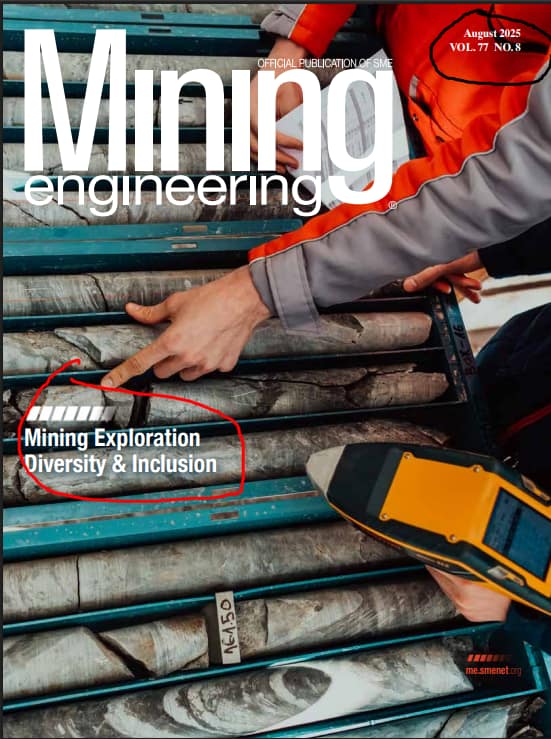
Lead articles:
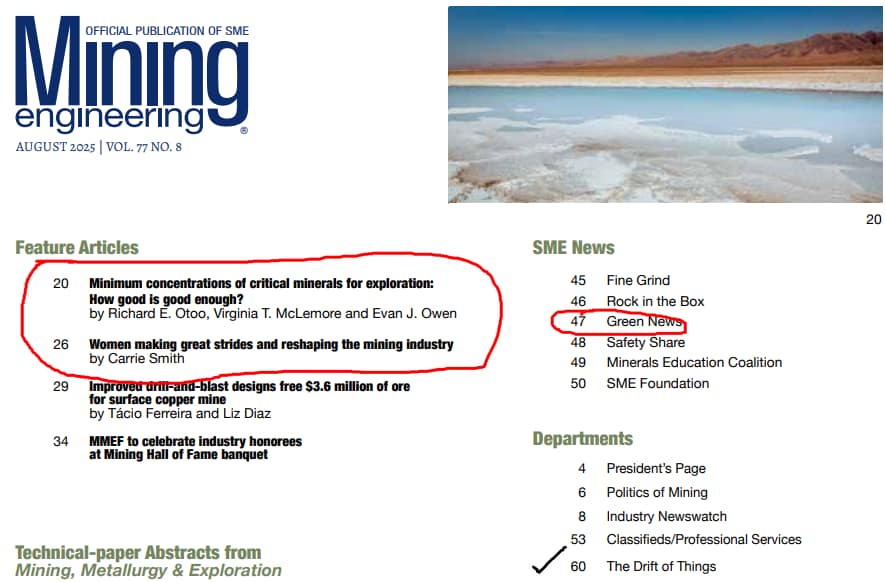
More of the same, right? One semi-bright spot: The article by the editor in The Drift of Things section about the MP Materials “public-private” partnership (free money) deal includes a short discussion of possible concerns about the deal in the 8th paragraph. “But the scale of the involvement has caused some concern in the mining sector. The Financial Times reported that some industry leaders and former government officials have expressed fear that the deal gives an unfair advantage to MP Materials.” And then goes on to happily talk about how this will help everybody. But at least a possible downside to this is mentioned somewhere in the magazine.
UPDATE: 25-12-15
Solution: 25-12-15. I am not renewing my SME membership for 2026. I’ve had enough of the woke, the grift and the pandering to the whim of the oligarchs, politicians, and defense contractors who run the empire. I will miss access to the library of AIME Transactions and other papers and abstracts, but c’est la vie du geologue.
Footnotes
1 Geologists are generally terrible at this, and it’s our downfall. We hand over our plans and sections, and nowadays, our block models, to the engineers, and we walk away. We’re done, either not interested, not able, or incapable. Being masters-of-the-universe-in-training, the engineers plan the pits with five phases, four stockpiles, and the biggest NPV they can muster even if the practicality of the mine plan is highly questionable. At this critical point in a new project or new mine plan, the geos don’t show up.
Many geologists don’t even take ownership of the model; maybe it was built by someone else. In many cases, some consultant in an office who has less than a couple of years of experience in an operating mine is building the company’s block model just because he can run some software package with a name borrowed from a cute amphibian.
Geologists are generally relegated to 3rd rank in the organization and sometimes deservedly so, because we should be reviewing a mine plan at the draft stage in the context of the geological variability, the limitations of accuracy of the model, the grade-tonnage curve, his/her actual experience in pits with blast movements, ore loss, and dilution, ore tracking screw-ups, inadequate grade control budgets and practices, and all that. But it is common that we are silent about potential problems in the largely digital mining plans. This contributes to underperformance and even failure in mine after mine. Luckily for the companies, the first crop of investors is replaced by a new group of optimists (or vultures) after the initial disappointments. But the failures and underperformance to expectations contribute to why mining is not well-financed and mining stocks are not widely held. But I digress — end of rant.
2 We trace the Equity component of D.E.I. to Chase P. Salmon, Abe Lincoln’s Secretary of the Treasury during the Civil War. Chase was one of three brothers and was the youngest of an impoverished family who faced a daily struggle for food and shelter. The younger Salmon was continually pursued by his older siblings at home and in the school. They even made threats to eat him one time when food was scarce. The larger, older Salmons were constantly in danger from their stepfather Griswold Lee Behr, who, while on family fishing trips in the river, would growl at them and swat them onto the riverbank with his big paws if they dared any flip remarks. Not all of them survived the depredations of Mr. Behr. These childhood experiences convinced Chase P. Salmon that it was better if everyone in society were the same size and got the same amount of food and other benefits. “From each according to his abilities, to each according to his needs” he said. That’s why as Sec’y of the Treasury he issued “greenbacks” to the people during the Civil War. If you look closely, you notice that the “all-seeing eye” you see on today’s greenback (Figure 2) is not a Masonic symbol, nor does it symbolize divine providence.
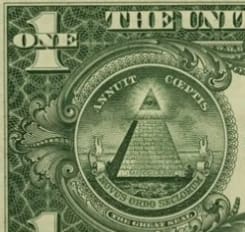
Figure 2 Detail of the back of current U.S. Federal Reserve note (courtesy of Shutterstock.com)
It is a fish eye, and undoubtedly a Salmon, a nod by the Federal Reserve in its creation of the latest generation of fiat money to the inspiration provided by the eponymous Chase P. Salmon. The inscription above the eye, “annuit coeptis”, refers to Salmon as “He” who favors this new greenback, and “novus ordo seclorum”, the saying below the pyramid, refers to the annual spawning of a new generation of fish, mostly suckers.
The story in the previous paragraph is made up, but it could’ve happened that way, don’t you think?
3 Not surprisingly, it will take some digging to find out the percentages of each use of each critical mineral or element. They all have multiple uses. It’s easy to find articles that show the actual and predicted amount of minerals for individual applications. I can’t find any tables that show a breakdown of the consumption of each “mineral” by application. If the data exists to show aggregate actual and predicted production and requirements to meet the “goals” as is discussed in articles, the individual component uses must exist in some database. At this writing, if a person wanted to find out what percentage of nickel is used by defense, I wouldn’t know where to send him to get that information.
4 Further notes on Redirection subcategories:
- “Critical Minerals” is now big. It’s the thing. Go get that Federal loan or subsidy and strap on the old feed bag. It’s surging…until the next government pulls the price supports
- “Green/Greenhouse” appears to have peaked but is still acceptable Newspeak.
- “Energy Transition/Transition” is still a thing.
- “Net-zero”: I guess it’s not a favorite term. Probably since it refers to a mathematical quantity, “zero”, too much information for the general public.
- “ESG”: Don’t worry, they are still doing it, but it’s a whisper now
- “Defense”: Up and down, but trend is up
- “Lithium” : Just won’t go away
- “Clean energy”: Give me a break. Clean, really? Seems to have peaked.
- “Battery Metals”: If this is the marketing pitch, try something else. Not working too well, especially with “Clean energy”.